
Reducing Wire Damage in Robotics with PET Sleeves


The Problem Nobody Designs for on Day One
When a robotic system is designed, everything looks perfect on paper. Cable routes are clean. Movements are simulated. Nothing seems to touch or rub.
Robots Move More Than Engineers Expect
Once a robot enters real production, movement patterns change. Cycles increase. Speeds go up. Small vibrations appear. Cables bend slightly more than planned and rub slightly longer than expected.
This is how wire damage begins—not with a mistake, but with normal operation.

Why Wire Failures Are So Misleading
Wire damage almost never fails instantly. That is why it is so often misdiagnosed.
Intermittent Errors Hide the Real Cause
A robot may stop once, then run again. Sensors appear unstable. Communication errors come and go. Maintenance teams often suspect software, controllers, or connectors.
Meanwhile, the cable insulation is slowly wearing through.
By the time copper wire is exposed, the system has already wasted hours—or days—on false troubleshooting.
The Cost Is Not the Repair, It’s the Interruption
Replacing a damaged cable is usually simple. What hurts is everything around that moment.
Production pauses. Operators wait. Schedules shift. Sometimes the line needs recalibration after the fix. None of this shows up in the cable’s price.
This is exactly why preventive protection matters—and why PET Sleeves are used by teams who care about uptime, not just specifications.

Why “Thicker Protection” Often Makes Things Worse
A common reaction to cable damage is adding more material: thicker jackets, rigid tubes, or heavy conduits.
Stiffness Creates New Stress
In robotics, stiffness works against you. Rigid protection increases bending resistance. Cables start fighting the motion of the robot instead of following it.
Internal conductors fatigue faster, especially at joints and tight curves.
PET Sleeves avoid this problem by protecting the surface without forcing the cable into a fixed shape.
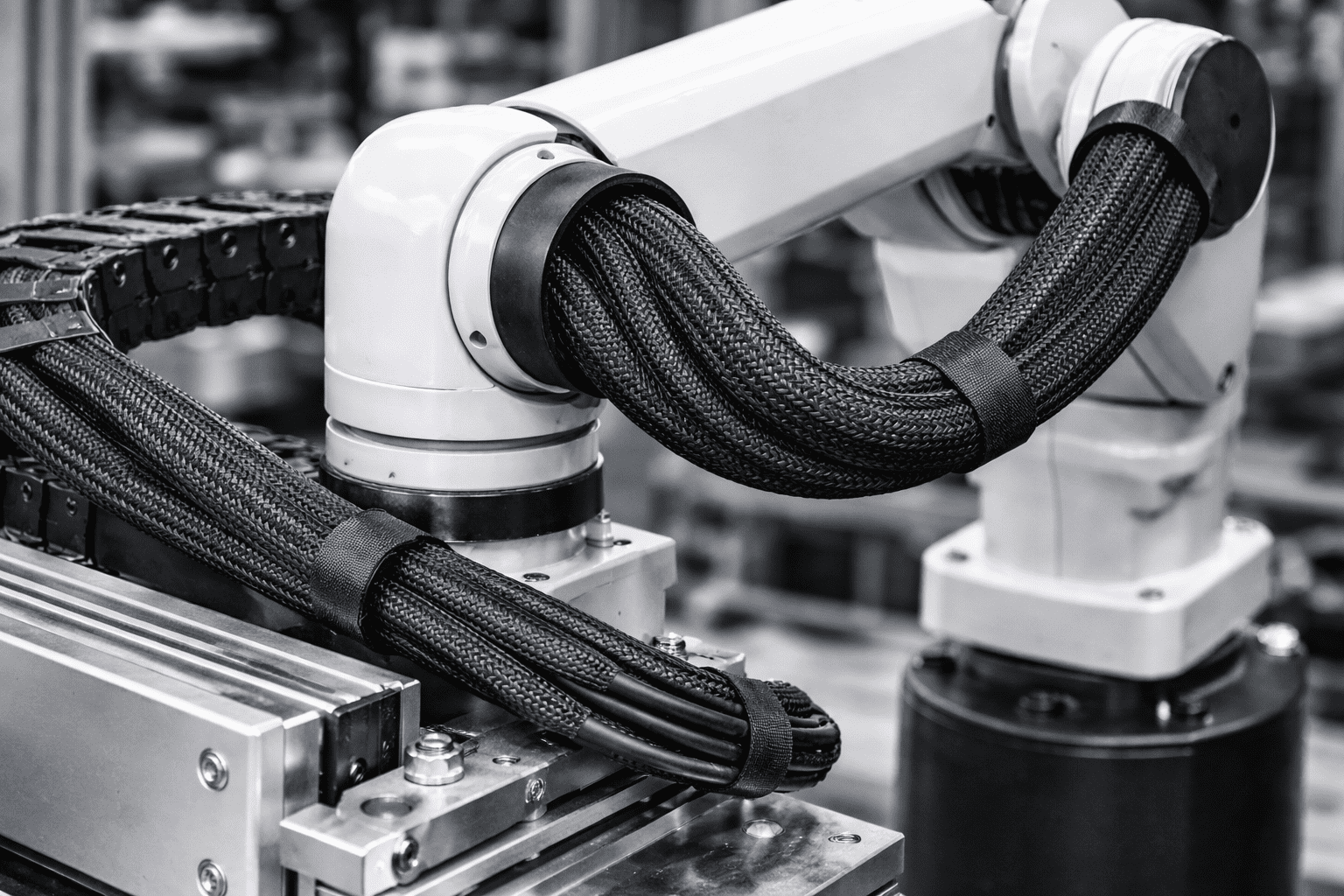
How PET Sleeves Work in Real Robotic Motion
The key advantage of PET Sleeves is not strength alone—it is how they behave during movement.
Protection That Moves With the Cable
The braided structure of PET Sleeves allows them to expand, contract, and shift slightly as the cable moves. This reduces concentrated stress at bending points.
Instead of resisting motion, PET Sleeves adapt to it. Over thousands of cycles, that difference becomes measurable.
Abrasion Is the Real Enemy
In most robotic applications, abrasion causes more damage than bending itself.
Where Damage Actually Happens
- Drag chain exits
- Robot arm joints
- Cable contact points near brackets
- Tight routing areas with vibration
In these locations, friction never stops. PET Sleeves act as a sacrificial layer, taking the wear before the cable insulation does. When the cable protective sleeve is worn, it is replaced. The cable survives.
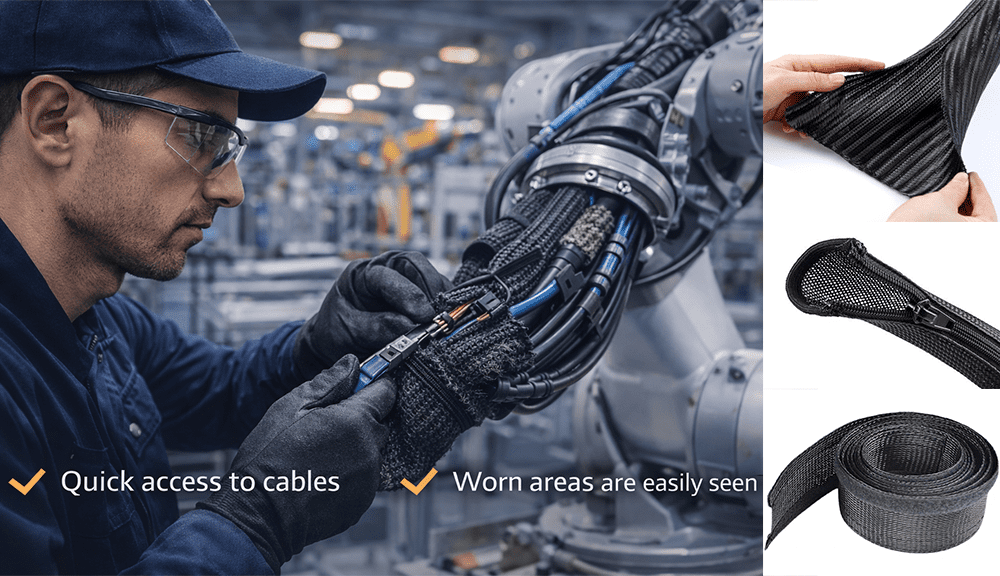
Why Maintenance Teams Choose PET Sleeves?
PET Sleeves includes PET expandable braided sleeving, Braided cable wrap, Hook & Loop Sleeves, Flame retardant braided sleeving, etcs.
Especial for PET expandable braided sleeving and Braided cable wrap.
- Built for Real Maintenance Work: PET expandable braided sleeving are designed for real maintenance situations, where technicians care about time, access, and visibility—not theory.
- Quick Installation, Less Downtime: They are easy to cut, install, and remove. No heat, no special tools, and no long production stops are required.
- Easy Visual Inspection: PET expandable braided sleeving have braided structure, it allows technicians to see the cable underneath. Signs of wear or damage can be noticed early, helping avoid unexpected failures.
- Faster On-site Decisions: Clear cable visibility makes inspections quicker and helps maintenance teams decide faster on repairs or replacements.
- Flexible Cable Access Options:PET expandable braided sleeving are closed design and Braided cable wrap are open (split) designs. Cables can be accessed, repaired, or replaced without removing the entire harness.
- Lower Maintenance Costs: Reduced downtime, less labor, and fewer emergency repairs help control overall maintenance costs.

Where PET Sleeves Deliver the Most Value
Not every cable needs extra protection. The value of PET Sleeves is highest where movement is constant and space is limited.
Typical High-Impact Applications
- Collaborative robots with continuous motion
- Pick-and-place systems
- Automated assembly lines
- Compact robotic cells with tight routing
In these environments, PET Sleeves,PET expandable braided sleeving consistently extend cable service life and reduce unplanned stops.
Reliability Comes from Small, Smart Choices
Robotic reliability is rarely improved by one big change. It improves through many small decisions made early.
Choosing the right PET Sleeving is one of those decisions.
They do not change how a robot works on day one. They change how long it keeps working after day one.
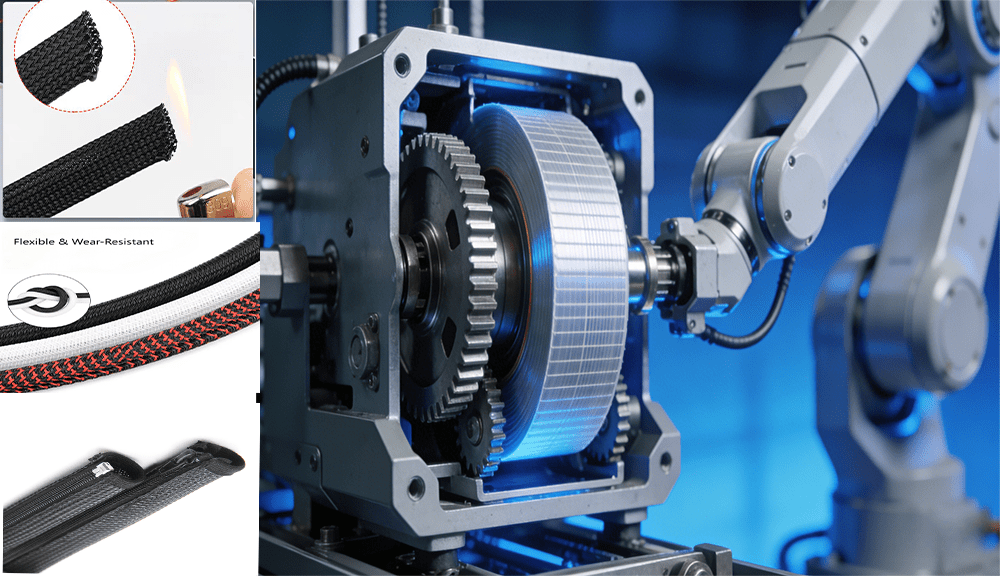
Conclusion: Solve the Quiet Problem Before It Gets Loud
Wire damage in robotics is predictable, repetitive, and expensive—yet often ignored. It does not announce itself until production is already affected.
By integrating PET Sleeves,PET expandable braided sleeving, Braided cable wrap,Hook & Loop Sleeves, Flame retardant braided sleeving and etcs into each robotic systems, engineers address a known weakness with a practical, proven solution. It is not an upgrade driven by trends, but by experience.
In modern automation, preventing failure is always cheaper than explaining it later.
Hey there, I’m Cheney!

If you have any questions about cable management sleeve protection, feel free to contact me.
Get A Quote


Related Post You May Also Like
How to Choose Self-Wrapping Split Braided Sleeving for EV Battery Cables
[pac_divi_table_of_contents included_headings="off|on|on|off|off|off" exclude_headings_by_class="on" active_link_highlight="on" level_markers_3="icons" title_container_padding="10px|15px|10px|15px|true|false" title_container_bg_color="#333333" body_area_height="650px"...

Application of Braided Split Wire Loom in Automotive Wiring Harness
[pac_divi_table_of_contents included_headings="off|on|on|off|off|off" exclude_headings_by_class="on" active_link_highlight="on" level_markers_3="icons" title_container_padding="10px|15px|10px|15px|true|false" title_container_bg_color="#333333" body_area_height="650px"...
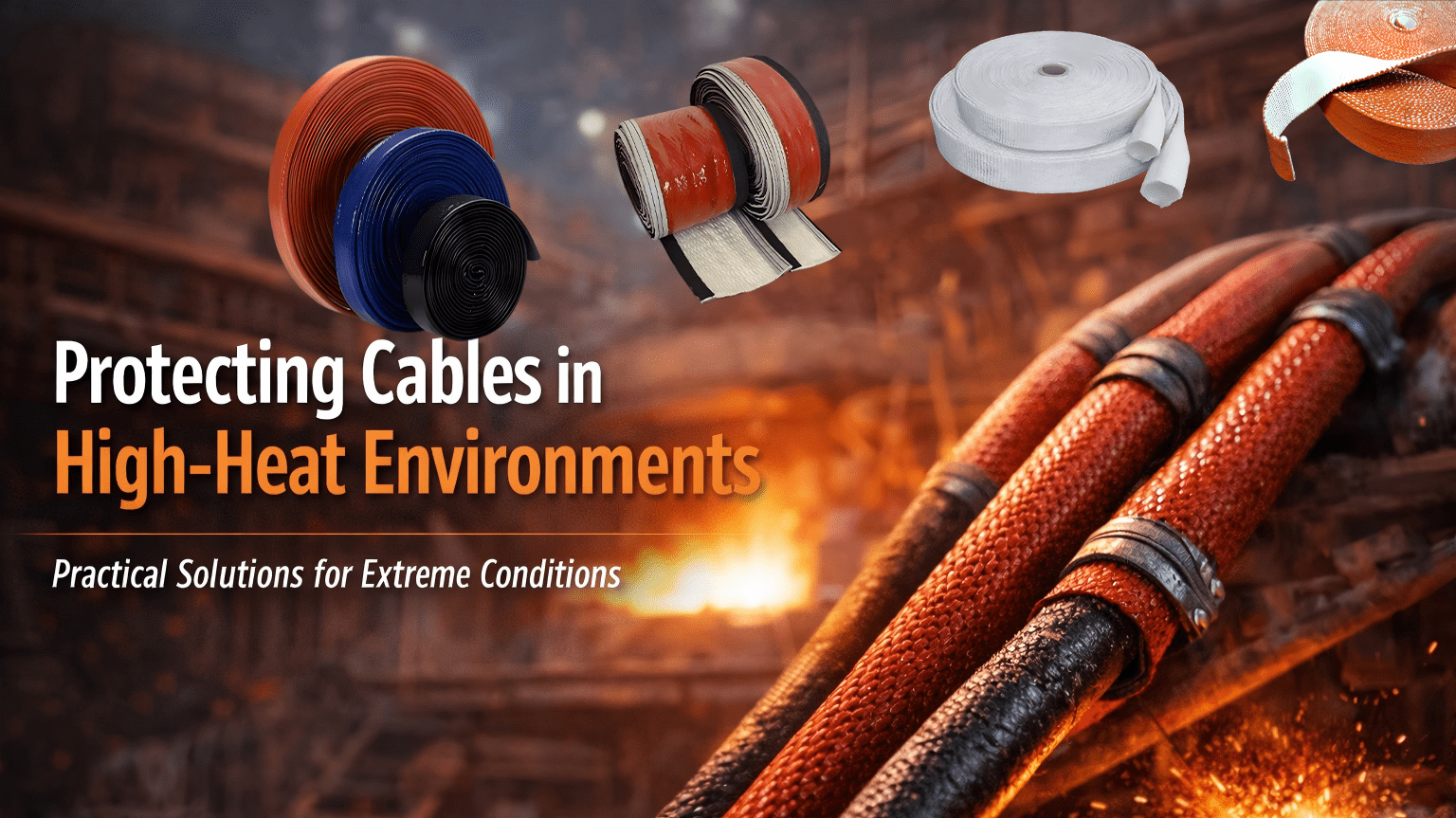
How Fire Sleeves Protect Cables in Extreme Heat Environments
[pac_divi_table_of_contents included_headings="off|on|on|off|off|off" exclude_headings_by_class="on" active_link_highlight="on" level_markers_3="icons" title_container_padding="10px|15px|10px|15px|true|false" title_container_bg_color="#333333" body_area_height="650px"...

How EKO Cable Sleeving Improved Safety in Automotive Applications
[pac_divi_table_of_contents included_headings="off|on|on|off|off|off" exclude_headings_by_class="on" active_link_highlight="on" level_markers_3="icons" title_container_padding="10px|15px|10px|15px|true|false" title_container_bg_color="#333333" body_area_height="650px"...
0 Comments